Vinyasa flow is a type of yoga that focuses on linking breath and movement, creating a fluid, flowing practice. It is a popular choice among yoga practitioners due to its dynamic and energizing nature, and there are numerous benefits to be gained from regularly incorporating vinyasa flow into your yoga routine. Here are five benefits of practising vinyasa flow:
Improved strength and flexibility
Vinyasa flow involves a variety of poses that require strength and flexibility, such as downward-facing dog, plank, and warrior poses. Regularly practicing these poses can help to improve both your strength and flexibility over time. This can not only make you feel physically stronger and more agile, but it can also help to reduce the risk of injury and improve your overall physical health.
Increased cardiovascular endurance
Vinyasa flow is a dynamic and fast-paced practice that can provide a cardiovascular workout. As you flow through the poses, your heart rate will increase, providing a cardiovascular benefit similar to that of other forms of exercise such as running or cycling. This can help to improve your endurance and cardiovascular health, making it a great option for those looking to improve their overall fitness.
Stress reduction
One of the primary benefits of yoga is its ability to help reduce stress and promote relaxation. Vinyasa flow, in particular, can be a great way to let go of stress and tension as you focus on your breath and movement. The combination of physical activity and mindfulness can help to calm the mind and bring a sense of peace and clarity.
Improved balance and coordination
Vinyasa flow involves a combination of poses that require balance and coordination, such as tree pose and crow pose. Practising these poses can help to improve your balance and coordination, which can have numerous benefits both on and off the mat. Improved balance and coordination can help to reduce the risk of falls and injuries, and can also help to improve your overall physical performance.
Improved mental focus and clarity
In addition to the physical benefits of vinyasa flow, the practice can also have a positive impact on your mental clarity and focus. As you focus on your breath and movement, you are able to let go of distractions and be fully present in the moment. This can help to improve your concentration and focus, and can also lead to a greater sense of clarity and peace of mind.
Overall, vinyasa flow is a dynamic and energizing form of yoga that offers numerous physical and mental benefits. Whether you are new to yoga or have been practicing for years, incorporating vinyasa flow into your routine can help to improve your strength, flexibility, cardiovascular endurance, balance, coordination, and mental focus. So why not give it a try and see the benefits for yourself?
If you’re interested in taking your yoga practice to the next level and becoming a certified yoga teacher, consider booking a free Discovery Call with Carmen to learn more about her yoga teacher mentoring program. During this call, you’ll have the opportunity to discuss your goals and aspirations as a yoga teacher, as well as learn more about the support and guidance Carmen offers through her mentorship program. Don’t miss this chance to learn from a seasoned professional and start your journey towards becoming a confident and skilled yoga teacher. Simply visit [insert website or contact information] to book your free Discovery Call with Carmen today!
https://carmenleeschneider.com/wp-content/uploads/2022/12/find-strength-flexibility-and-clarity-5-benefits-of-vinyasa-flow-yoga.jpg6671000adminadmin2022-12-22 07:38:062024-04-11 15:05:28Find Strength, Flexibility, and Clarity: 5 Benefits of Vinyasa Flow Yoga
As we get older, it often feels as though time is speeding up. Years fly by faster and precious moments that seemed to last a lifetime during childhood, now just seem to evaporate into thin air…
But it doesn’t have to be like that.
There are ways to change our perception of time. The key is to slow down the pace of life while increasing the amount of new and unique experiences we have. When we keep going to the same places, doing the same things over and over, we don’t create distinct memories. As a result, time seems to fly by us as the monotone nature of your days simply merges into what seems like one and the same memory.
When we make an effort to travel more often, and to stay open to learning new things and creating new unique experiences, our perception of time slows down again.
Also, focus on positive past memories and try to live more in the present. Holding a positive perception of the future and envisioning a future full of hope and optimism will vastly increase your level of happiness. Learn to love yourself more and make time to meditate regularly. Time with yourself is incredibly important and helps us to reflect and appreciate life more.
Learn to appreciate each moment and use your time wisely. The time we have on this planet is precious. Let’s make the most of each day we have.
Namaste,
Carmen
https://carmenleeschneider.com/wp-content/uploads/2021/03/yogab.jpeg640960Carmen Lee-SchneiderCarmen Lee-Schneider2021-03-24 18:59:192021-10-30 19:11:18Have you noticed time passing faster as you get older?
Since you are here reading this article, you might have attended one or more yoga classes, or maybe you’re on the search for ways to improve your life and stumbled upon yoga. Perhaps you have just gotten out of a long-term relationship or work is usurping all your energy. Whatever it might be, a regular yoga practice has the power to significantly improve your life and change it for the better. If you want to practise with me, have a browse through my online classes over at Love Life. Live Yoga.
And now, here are 5 ways in which yoga can improve your life.
1. Taking Yoga Classes will Help you Lose Weight and Keep it Off
If you have been packing weight in all the wrong places, your health can deteriorate and your self-esteem will take a hit. Are you finding it hard to stick to your weight loss program or a healthy diet? If yes, taking yoga can do the trick.
Yoga classes in Bundaberg allow you to connect with your inner self and be in harmony with your emotions. Thanks to yoga, you will be able to kick your food cravings, stick to your exercising, and eventually shed a few pounds. It is incredible how much easier it is to stay focused and not lose track of your life’s purpose when you embrace yoga.
2. Yoga Helps Relief Pains and Aches
Perhaps you’ve taken a brunt of a beating from persistent back pains, migraines or even headaches. You see, pain can greatly affect the quality of your life. And today’s over-the-counter and prescription pain medication can do more harm than good. If you’re sailing in this boat, taking yoga classes can help you make the shift to a healthier, happier you.
Click here for a FREE 7-Day Trial to access unlimited online classes with Carmen.
3. Yoga Helps You Stay Stress-Free
Before taking yoga classes, it’ll probably be hard for you to admit that you are stressed out or depressed. The truth is stress from life’s ups and downs can take a toll on your work performance, happiness, and overall well-being. Thankfully, yoga can help calm your mind, reduce stress hormones, and keep anxiety at bay.
4. Yoga Can Improve Your Self-Esteem and Confidence
Yoga classes allow you to work on your 3rd chakra. This is the core area that can help you gain lots of willpower, confidence, and resolve. If you have not had the guts to switch careers or face life challenges, yoga will help give you enough confidence to finally do so. This way, you can live a happier and a healthier life and be more true to yourself.
5. Yoga Can Improve Your Life by Helping Meet New People and Make Friends
The primary reason most yogis find yoga so alluring is that it gives you an opportunity to connect with an entirely new group of friends. Although you will still be in touch with most of your old friends, you will find fellow yogis to make interesting new friendships with. Most of the people you’ll meet at yoga classes are charming, friendly, understanding and down to earth. If you are not ready to attend regular classes, a beginner’s workshop or yoga retreat could a great way to ease in to your new way of life.
When combined, all these benefits of yoga can be truly life-changing.
Watch how yoga has helped these people improve their lives
https://carmenleeschneider.com/wp-content/uploads/2018/05/how-yoga-can-improve-your-life-carmen-leeschneider.jpg7851400Carmen Lee-SchneiderCarmen Lee-Schneider2021-01-28 01:12:582021-10-30 10:03:295 Ways Yoga Can Improve Your Life
If you’re dealing with back pain, yoga may be just what the doctor ordered. Yoga is a mind-body therapy that’s often recommended to treat not only back pain but the stress that accompanies it. The appropriate poses can relax and strengthen your body.
You may have heard that yoga can be beneficial when it comes to back pain. Here are 10 poses to try, why it works & more.
Practicing yoga for even a few minutes a day can help you gain more awareness of your body. This will help you notice where you’re holding tension and where you have imbalances. You can use this awareness to bring yourself into balance and alignment.
Keep reading to learn more about how these poses may be useful in treating back pain.
1. Cat-Cow
This gentle, accessible backbend stretches and mobilises the spine. Practicing this pose also stretches your torso, shoulders, and neck.
Muscles worked:
erector spinae
rectus abdominis
triceps
serratus anterior
gluteus maximus
To do this:
Get on all fours.
Place your wrists underneath your shoulders and your knees underneath your hips.
Balance your weight evenly between all four points.
Inhale as you look up and let your stomach drop down toward the mat.
Exhale as you tuck your chin into your chest, draw your navel toward your spine, and arch your spine toward the ceiling.
Maintain awareness of your body as you do this movement.
Focus on noting and releasing tension in your body.
Continue this fluid movement for at least 1 minute.
2. Downward-Facing Dog
This traditional forward bend can be restful and rejuvenating. Practicing this pose can help relieve back pain and sciatica. It helps to work out imbalances in the body and improves strength.
Muscles worked:
hamstrings
deltoids
gluteus maximus
triceps
quadriceps
To do this:
Get on all fours.
Place your hands in alignment under your wrists and your knees under your hips.
Press into your hands, tuck your toes under, and lift up your knees.
Bring your sitting bones up toward the ceiling.
Keep a slight bend in your knees and lengthen your spine and tailbone.
Keep your heels slightly off the ground.
Press firmly into your hands.
Distribute your weight evenly between both sides of your body, paying attention to the position of your hips and shoulders.
Keep your head in line with your upper arms or with your chin tucked in slightly.
Hold this pose for up to 1 minute.
3. Extended Triangle
This classic standing posture may help alleviate backache, sciatica, and neck pain. It stretches your spine, hips, and groin, and strengthens your shoulders, chest, and legs. It may also help relieve stress and anxiety.
Muscles worked:
latissimus dorsi
internal oblique
gluteus maximus and medius
hamstrings
quadriceps
To do this:
From standing, walk your feet about 4 feet apart.
Turn your right toes to face forward, and your left toes out at an angle.
Lift your arms parallel to the floor with your palms facing down.
Tilt forward and hinge at your right hip to come forward with your arm and torso.
Bring your hand to your leg, a yoga block, or onto the floor.
Extend your left arm up toward the ceiling.
Look up, forward, or down.
Hold this pose for up to 1 minute.
Repeat on the opposite side.
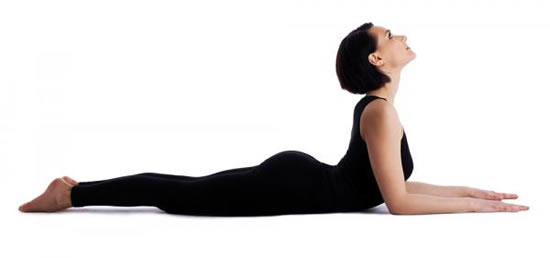
4. Sphinx Pose
This gentle backbend strengthens your spine and buttocks. It stretches your chest, shoulders, and abdomen. It may also help relieve stress.
Muscles worked:
erector spinae
gluteal muscles
pectoralis major
trapezius
latissimus dorsi
To do this:
Lie on your stomach with your legs extended behind you.
Engage the muscles of your lower back, buttocks, and thighs.
Bring your elbows under your shoulders with your forearms on the floor and your palms facing down.
Slowly lift up your upper torso and head.
Gently lift and engage your lower abdominals to support your back.
Ensure that you’re lifting up through your spine and out through the crown of your head, instead of collapsing into your lower back.
Keep your gaze straight ahead as you fully relax in this pose, while at the same time remaining active and engaged.
Stay in this pose for up to 5 minutes.
5. Cobra Pose
This gentle backbend stretches your abdomen, chest, and shoulders. Practicing this pose strengthens your spine and may soothe sciatica. It may also help to relieve stress and fatigue that can accompany back pain.
Muscles worked:
hamstrings
gluteus maximus
deltoids
triceps
serratus anterior
To do this:
Lie on your stomach with your hands under your shoulders and your fingers facing forward.
Draw your arms in tightly to your chest. Don’t allow your elbows to go out to the side.
Press into your hands to slowly lift your head, chest, and shoulders.
You can lift partway, halfway, or all the way up.
Maintain a slight bend in your elbows.
You can let your head drop back to deepen the pose.
Release back down to your mat on an exhale.
Bring your arms by your side and rest your head.
Slowly move your hips from side to side to release tension from your lower back.
6. Locust Pose
This gentle backbend may help relieve lower back pain and fatigue. It strengthens the back torso, arms, and legs.
Muscles worked:
trapezius
erector spinae
gluteus maximus
triceps
To do this:
Lie on your stomach with your arms next to your torso and your palms facing up.
Touch your big toes together and turn out your heels to the side.
Place your forehead lightly on the floor.
Slowly lift your head, chest, and arms partway, halfway, or all the way up.
You may bring your hands together and interlace your fingers behind your back.
To deepen the pose, lift your legs.
Look straight ahead or slightly upward as you lengthen the back of your neck.
Remain in this pose for up to 1 minute.
Rest before repeating the pose.
7. Bridge Pose
This is a backbend and inversion that can be stimulating or restorative. It stretches the spine and it may relieve backaches and headaches.
Muscles worked:
rectus and transverse abdominis
gluteus muscles
erector spinae
hamstrings
To do this:
Lie on your back with your knees bent and heels drawn into your sitting bones.
Rest your arms alongside your body.
Press your feet and arms into the floor as you lift your tailbone up.
Continue lifting until your thighs are parallel to the floor.
Leave your arms as they are, bringing your palms together with interlaced fingers under your hips, or placing your hands under your hips for support.
Hold this pose for up to 1 minute.
Release by slowly rolling your spine back down to the floor, vertebra by vertebra.
Drop your knees in together.
Relax and breathe deeply in this position.
8. Half Lord of the Fishes
This twisting pose energizes your spine and helps to relieve backache. It stretches your hips, shoulders, and neck. This pose can help alleviate fatigue and stimulate your internal organs.
Muscles worked:
rhomboids
serratus anterior
erector spinae
pectoralis major
psoas
To do this:
From a seated position, draw your right foot in close to your body.
Bring your left foot to the outside of your leg.
Lengthen your spine as you twist your body to the left.
Take your left hand to the floor behind you for support.
Move your right upper arm to the outside of your left thigh, or wrap your elbow around your left knee.
Try to keep your hips square to deepen the twist in your spine.
Turn your gaze to look over either shoulder.
Hold this pose for up to 1 minute.
Repeat on the other side.
Ask a Yoga Teacher
Get answers to all your questions from a professional yoga instructor
Have questions about yoga? We’ve answered frequently asked yoga questions to help you find out if yoga classes are right for you.
9. Two-Knee Spinal Twist
This restorative twist promotes movement and mobility in the spine and back. It stretches your spine, back, and shoulders. Practicing this pose can help relieve pain and stiffness in your back and hips.
Muscles worked:
erector spinae
rectus abdominis
trapezius
pectoralis major
To do this:
Lie on your back with your knees drawn into your chest and your arms extended to the side.
Slowly lower your legs to the left side while keeping your knees as close together as possible.
You may place a pillow under both knees or in between your knees.
You can use your left hand to gently press down on your knees.
Keep your neck straight, or turn it to either side.
Focus on breathing deeply in this position.
Hold this pose for at least 30 seconds.
Repeat on the opposite side.
10. Child’s Pose
This gentle forward fold is the perfect way to relax and release tension in your neck and back. Your spine is lengthened and stretched. Child’s Pose also stretches your hips, thighs, and ankles. Practicing this pose can help relieve stress and fatigue.
Muscles worked:
gluteus maximus
rotator cuff muscles
hamstrings
spinal extensors
To do this:
Sit back on your heels with your knees together.
You can use a bolster or blanket under your thighs, torso, or forehead for support.
Bend forward and walk your hands in front of you.
Rest your forehead gently on the floor.
Keep your arms extended in front of you or bring your arms alongside your body with your palms facing up.
Focus on releasing tension in your back as your upper body falls heavy into your knees.
Remain in this pose for up to 5 minutes.
Does it really work?
One small study from 2017 assessed the effects of either yoga practice or physical therapy over the course of one year. The participants had chronic back pain and showed similar improvement in pain and activity limitation. Both groups were less likely to use pain medications after three months.
Separate research from 2017 found that people who practiced yoga showed small to moderate decreases in pain intensity in the short term. Practice was also found to slightly increase participants’ short- and long-term function.
Apart from back pain, yoga is known to help with countless other conditions, such as depression, anxiety and difficulty with concentration, just to name a few.
The bottom line
Although recent research supports yoga practice as a way to treat back pain, it may not be appropriate for everyone. Be sure to talk with your doctor before starting any new yoga or exercise program. They can help you identify any possible risks and help monitor your progress.
You can start a home practice with as little as 10 minutes per day. You can use books, articles, and yoga classes to guide your practice.
If you prefer more hands-on learning, you may wish to take classes at a Bundaberg yoga studio. It’s important to seek out classes and teachers who can cater to your specific needs.
https://carmenleeschneider.com/wp-content/uploads/2021/12/YogaFlow.jpg578850Carmen Lee-SchneiderCarmen Lee-Schneider2019-03-29 14:57:442022-02-24 16:34:49Yoga For Back Pain – 10 Yoga Poses To Strengthen Your Back & Ease Your Pain
It’s no big secret that there are several different mental benefits of yoga that can do wonders for every aspect of your being. It can rejuvenate your mind, reinvigorate your body, and recharge your spirit. As such, the benefits of yoga cut across the physical, mental, and spiritual spectrum.
In this post, however, we shall only cover the top mental benefits of yoga
#1. Yoga Sharpens your Concentration and Memory Focus
With each yoga pose, yogis can spruce up their brain function and health. In fact, certain yoga poses and techniques have been found to stimulate the nervous system and brain. The result is improved mental focus and sharpened concentration. Moreover, yoga helps your brain become pliable so it can process information more efficiently and quickly.
#2. Yoga Helps Relieve Anxiety and Stress
Stress and anxiety relief is one of the most important mental yoga benefits. You see, your body and mind can take a beating from anxiety attacks and stress. In fact, recent studies have shown that increased levels of stress hormones (called cortisol) can lead to pain, loss of sleep, and other lifestyle ailments. The relaxation, calmness and fluidity that come with regular yoga practice has been found to reduce not only these stress hormones, but also anxiety.
#3. Yoga Uplifts your Mood as one of the Mental Benefits
Just likeother forms of exercise, vinyasa yoga can help induce the secretion of more “feel good” neurotransmitters, including endorphins, serotonin, and dopamine. These are hormones that regulate happiness and rewarding behaviour. At the same time, yoga reduces stress and the mood-depressing hormone called cortisol. That’s why it comes as no big surprise that yoga can work wonders for cancer and dementia patients. However, anyone can benefit from an uplifted mood.
#4. Yoga Improves Mindfulness
Mindfulness is crucial when it comes to collecting your thoughts and living in the present moment. When combined with other practices like meditation, yoga can help you become mindful of yourself, of your thoughts, and of others. More importantly, getting started with mindfulness allows you to be in sync with your emotions and be in a better position to take on life’s ups and downs. What’s more, mindfulness has been found to help boost the immune system and improve relationships.
#5. Yoga and Sleep Disorders
One of the biggest mental yoga benefits is that it can help treat insomnia and other sleep disorders. By improving your mindfulness and relaxing your mind, yoga can indeed help you sleep better and aid your body to recover faster.
#6. Yoga can Slow Down Cognitive Decline
A recent 12-week-long study has shown that yoga can effectively combat cognitive degeneration. It not only improves memory but also boost regeneration of brain cells.
There you have it — 6 mental benefits of yoga for your brain and mental health. Yoga is also recommended to help fight depression as well as treat PTSD and schizophrenia.
https://carmenleeschneider.com/wp-content/uploads/2018/05/The-Top-6-Mental-Benefits-of-Yoga-Love-Life.-Live-Yoga.jpg6671000Carmen Lee-SchneiderCarmen Lee-Schneider2018-05-28 00:51:592024-04-11 15:14:236 Mental Benefits of Yoga

 Carmen Lee-Schneider
 Carmen Lee-Schneider